Precision bar turning in Haute-Savoie

Founded in 2000 as a distributor of turned parts, ARCOM Industrie now manufactures its own bar-turned parts in Haute-Savoie. Using sliding-headstock, multi-spindle and twin-spindle CNC lathes, we produce turned parts from Ø 0.5 to 65 mm, from prototypes to large series, inspected and ready for integration.

What is bar turning?

Bar turning is a material-removal machining process that produces turned parts in series from metal or plastic bars. The bar feeds through an automatic lathe, the tools shape the part, then the part is parted off and the bar advances for the next one. It is the ideal process for small, precise parts made in large quantities, for example:

  1. Shafts and spindles
  2. Screws and threaded parts
  3. Fittings and valve components
  4. Medical device components

Born out of watchmaking, bar turning developed in the Arve valley, which today accounts for most of France’s bar turning activity. ARCOM Industrie is based at the heart of this industrial area, in Saint-Pierre-en-Faucigny.

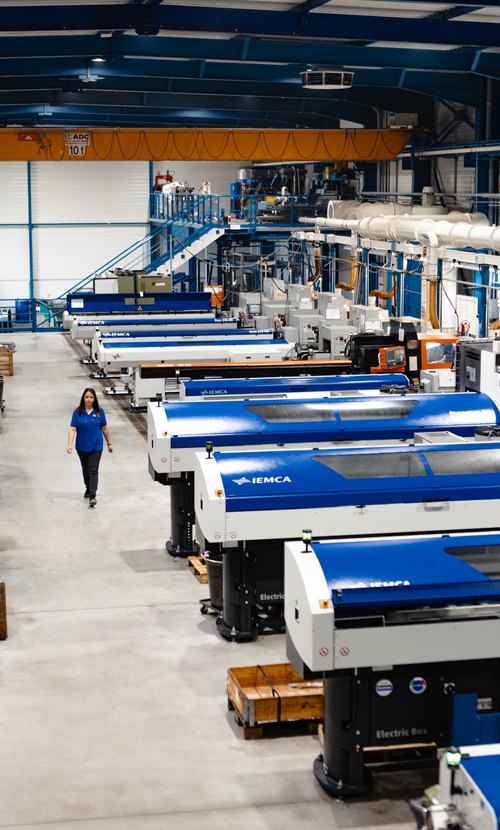
Bar feeders lined up in the ARCOM bar turning workshop
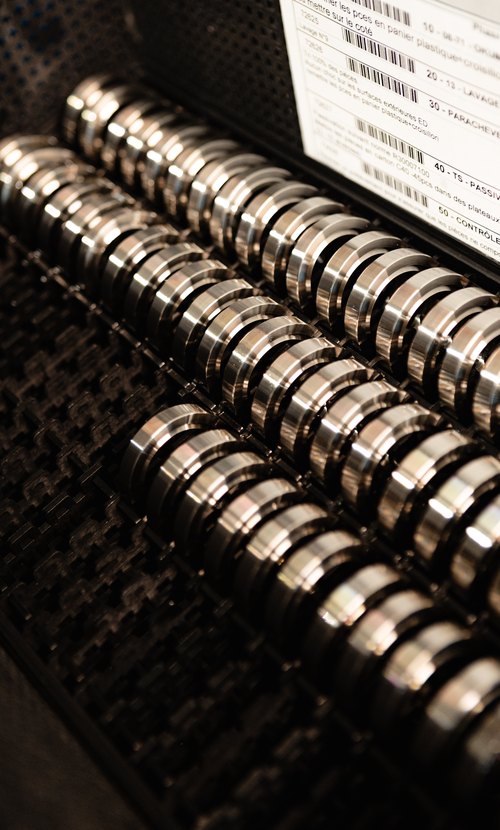
Turned parts arranged in series on their holder
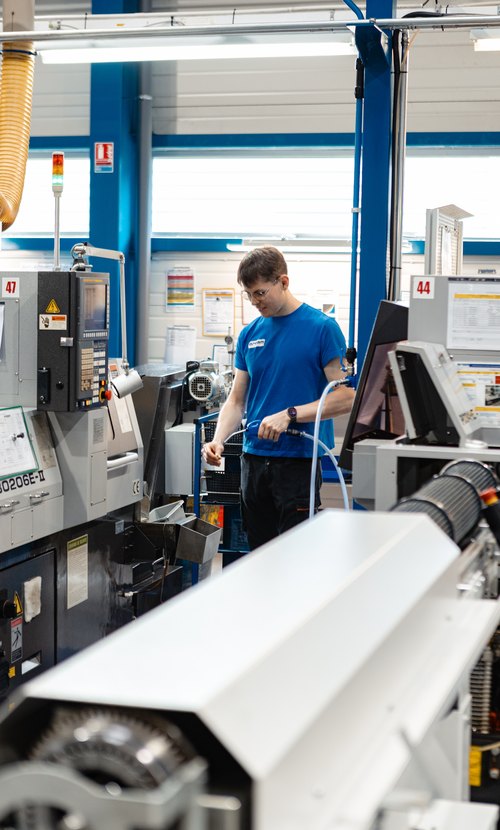
Operator at a Tsugami sliding-headstock CNC lathe
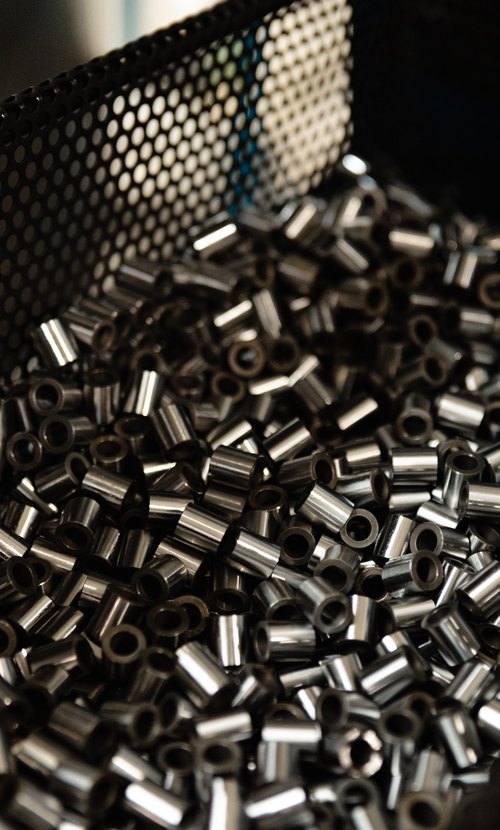
Batch of small turned parts in a perforated basket

Our bar turning equipment

Each technology suits a type of part. We choose the machine according to the diameter, geometry and production volume, to strike the right balance between precision and cost.

Sliding-headstock CNC lathes

Ø 0.5 to Ø 32 mm – long, slender parts, guided right next to the tool

Multi-spindle lathes

Ø 16 mm maximum – batches of more than 30,000 parts

Twin-spindle CNC lathes

Ø 10 to Ø 65 mm – medium-diameter parts

CNC chucking lathes

Ø 250 mm maximum – large-diameter parts

The materials we bar turn

We bar turn metals as well as engineering plastics: 316L, 304L and 17-4PH stainless steel, titanium, superalloys such as Inconel, Hastelloy or Monel, tungsten, aluminium, brass and copper, PEEK, POM, PTFE and PA6. Chip formation, heat build-up, tool wear: each material needs its own tools and cutting parameters. An in-house passivation line then treats stainless steel and titanium parts.

Each material behaves differently when cut. We take this into account from the very first study of the part.

Bar-turned parts for demanding industries

Our bar-turned parts go to industries where compliance is not negotiable. For fluidics, fittings and valve components with metric, UNC, UNF, NPT, PG or Whitworth threads. For the medical sector, components in TA6V ELI titanium or 316LVM stainless steel. For machine tools, shafts, spindles and balancing screws. And for aerospace, parts for engines and landing gear.

Industry and machinery

Production of technical parts and sub-assemblies for integration into a wide range of industrial equipment.

Defence and armament

Production of mechanical components for applications requiring robustness, precision and production traceability.

Aerospace

Machining technical parts that meet tight dimensional constraints and the specific reliability requirements of these markets.

Vacuum and ultra-high vacuum (UHV)

Manufacture of parts for vacuum environments requiring controlled surface finishes, material compatibility and leak-tightness.

Nuclear

Production of components for regulated environments requiring rigorous inspection, documentation and compliance with industry requirements.

Fluidics

Production of parts and sub-assemblies for fluid circulation systems requiring leak-tightness, dimensional precision and in-service stability.

Medical and instrumentation

Manufacture of components for medical devices and technical instruments requiring traceability, tolerance control and material compatibility. Discover precision machining

Inspection and traceability for every series

In bar turning, any drift is repeated across thousands of parts. Our production is therefore monitored with ELLISTAT, which controls the processes and flags any drift, then inspected in our metrology lab: CMM, Keyence and VICI VISION optical measurement, roughness tester. Material and process traceability is part of a quality system certified to ISO 9001, ISO 13485, ISO 14001 and EN 9100.

Dimensional inspection of a part with a measuring instrument

Our expertise

Bar turning

Sliding-headstock, multi-spindle and twin-spindle CNC lathes producing turned parts from Ø 0.5 to 65 mm, from prototypes to large series.

Metrology and inspection

Coordinate measuring, roughness testing, optical inspection and traceability ensure dimensional compliance and production validation in line with industry requirements.

Assembly

Sub-assembly integration, additional operations and specific tests enable us to deliver components ready to integrate into complex industrial systems.

Laser marking and welding

Laser marking for traceability, micro-welding and specific operations suited to regulated technical environments.

Prototyping & pre-series support

Technical analysis, feasibility validation and industrialisation preparation smooth the transition from prototype to series production.

Precision machining

5-axis milling, turning, complex bar turning and EDM enable us to produce technical parts with controlled tolerances and surface finishes suited to integration constraints.

Our other industrial expertise

Frequently asked questions about bar turning

What is the difference between bar turning and turning?
close open

Bar turning is a form of turning. We speak of bar turning when the part is machined directly from a bar on an automatic lathe, then separated from the bar at the end of the cycle. It is the most efficient way to produce small and medium-diameter turned parts in series. Turning in the broader sense also covers larger-diameter parts machined from blanks, as one-offs or in series.

From bar, Ø 0.5 to Ø 65 mm: up to Ø 32 mm on our sliding-headstock lathes, up to Ø 16 mm on our multi-spindle lathes and Ø 10 to Ø 65 mm on our twin-spindle lathes. For larger parts, our CNC chucking lathes go up to Ø 250 mm.

It depends on the part and the machine. Our multi-spindle lathes are built for very large series, above 30,000 parts. On our CNC lathes, we produce series from 250 parts. We also support prototype and pre-series phases before production starts.

Stainless steels (316L, 304L, 17-4PH) and engineering steels, titanium, superalloys such as Inconel, Hastelloy or Monel, tungsten, aluminium, brass, copper and engineering plastics (PEEK, POM, PTFE, PA6). Tools and cutting parameters are adapted to each material.

Yes. Depending on your needs, we complete bar turning with passivation of stainless steel and titanium, vacuum cleaning with modified alcohol, laser marking for traceability, laser micro-welding and sub-assembly, with leak testing where required. You receive inspected parts, ready for integration.

ARCOM Industrie is certified to ISO 9001, ISO 13485 for medical devices, EN 9100 for aerospace and ISO 14001 for the environment. The certificates are available in our download area.

The easiest way is to use our contact form, attaching your drawing or specifications. Our teams study the feasibility, material and production volume to define the most suitable manufacturing strategy.

A bar turning project?

Our teams analyse your dimensional, material and production volume constraints to define a suitable industrialisation strategy.

Are you developing a part to be bar turned, or looking to industrialise an existing production?