Manufacture of components for the distribution and control of fluids

The fluidics sector involves manufacturing components for circulating and controlling fluids under pressure or with sealing constraints.

ARCOM Industrie produces technical parts and sub-assemblies for pneumatic, hydraulic and gas systems, taking into account the dimensional and functional requirements specific to these applications.

Constraints specific to fluid distribution

Fluidic components include sealing areas and sensitive functional surfaces.

Controlled surface finishes, burr-free edges and precise bearing surfaces are critical to ensure the assemblies work properly.

Consistent production and reliable deliveries are also key criteria in this market, which often has fast-changing production needs.

Fluidic components are made from stainless steel, aluminium, steel, brass or nickel-based alloys such as Hastelloy or Monel, depending on pressure, corrosion and operating environment constraints.

The choice of material depends on the functional and mechanical constraints and on the device's operating environment.

Industrial processes used to manufacture fluidic components

Manufacturing fluidic components draws on precision machining and bar turning, with particular attention to functional and sealing areas.

Depending on the application, ARCOM Industrie also carries out additional operations such as laser marking for identification or specific finishes such as anodising.

Metrology and inspection

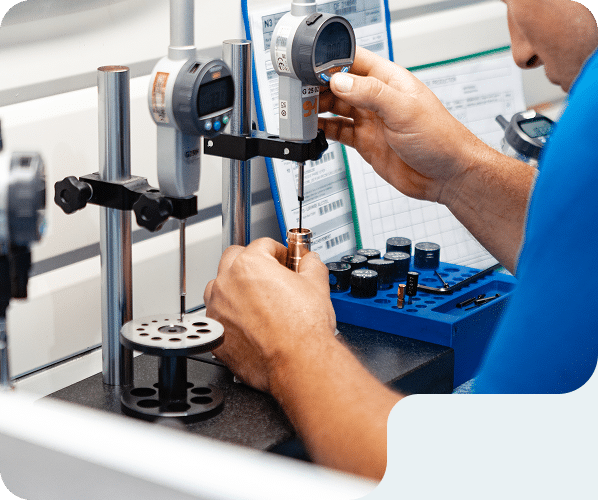
Coordinate measuring, roughness testing, optical inspection and traceability ensure dimensional compliance and production validation in line with industry requirements.

Assembly

Sub-assembly integration, additional operations and specific tests enable us to deliver components ready to integrate into complex industrial systems.

Laser marking and welding

Laser marking for traceability, micro-welding and specific operations suited to regulated technical environments.

Prototyping & pre-series support

Technical analysis, feasibility validation and industrialisation preparation smooth the transition from prototype to series production.

Precision machining

5-axis milling, turning, complex bar turning and EDM enable us to produce technical parts with controlled tolerances and surface finishes suited to integration constraints.

Applications

Our parts are used in particular in the following sectors:

  • Pneumatics
  • Hydraulics
  • Gas
  • Petroleum
  • Food applications

Threads and technical configurations

Manufacturing fittings and fluidic components involves many thread configurations. ARCOM Industrie produces metric, ISO, UNC, UNF, NPT, PG and Whitworth threads, among others, according to the specification. Our machine fleet can also produce parts up to Ø 250 mm.

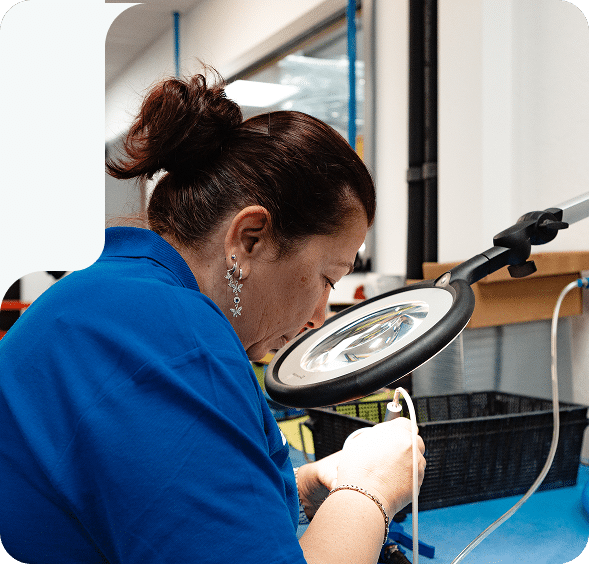
Visual inspection of a part under a magnifying glass

Our industries

Industry and machinery

Production of technical parts and sub-assemblies for integration into a wide range of industrial equipment.

Defence and armament

Production of mechanical components for applications requiring robustness, precision and production traceability.

Aerospace

Machining technical parts that meet tight dimensional constraints and the specific reliability requirements of these markets.

Vacuum and ultra-high vacuum (UHV)

Manufacture of parts for vacuum environments requiring controlled surface finishes, material compatibility and leak-tightness.

Nuclear

Production of components for regulated environments requiring rigorous inspection, documentation and compliance with industry requirements.

Fluidics

Production of parts and sub-assemblies for fluid circulation systems requiring leak-tightness, dimensional precision and in-service stability.

Medical and instrumentation

Manufacture of components for medical devices and technical instruments requiring traceability, tolerance control and material compatibility. Discover precision machining

Our other industrial expertise

A project in fluidics?

Are you developing a fitting, a valve or a component for a fluid distribution system?

Our teams support you in industrialising your parts, taking into account the sealing, repeatability and production rate constraints specific to this market.