Tungsten and molybdenum: precision machining for demanding industrial applications

Machining tungsten and molybdenum is not something you improvise. Their extreme density and exceptional melting point demand cutting expertise that few workshops master. At ARCOM, we don't let these materials dictate to us: we adapt our tooling strategies to secure your critical parts for the harshest thermal and mechanical environments.

Technical properties of tungsten and molybdenum

Tungsten stands out for:

  1. An extremely high density.
  2. One of the highest melting points of any metal.
  3. High wear resistance.
  4. Excellent dimensional stability.
  5. Very good high-temperature resistance.
  6. An excellent metal for radiation shielding

These characteristics make it a strategic material for industrial environments requiring strength, compactness and thermal stability.

ARCOM Industrie also occasionally machines parts in molybdenum, a refractory material with high thermal properties used in certain specific environments.

Employee at the workshop computer station
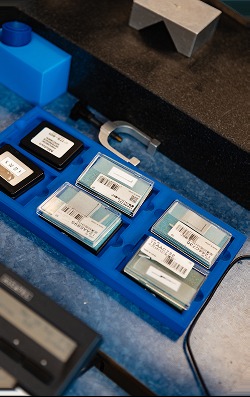
Gauge blocks and micrometer on an inspection plate in ARCOM Industrie's metrology lab
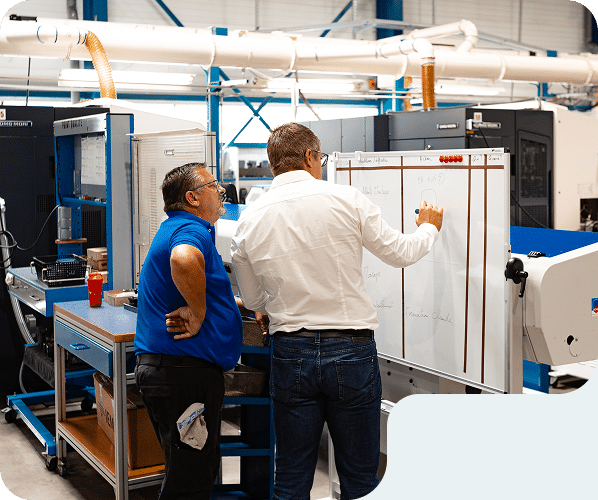
Workshop aisle with bar turning machines
Programming and production monitoring station

Our industrial expertise in tungsten

Our machine fleet and organisation allow us to handle technical parts in tungsten and molybdenum from prototype to series production.

Tungsten and molybdenum are hard, demanding materials to machine. Their high density and mechanical strength call for a rigorous approach.

ARCOM Industrie adapts its machining strategies through the selection of specific tooling, precise setting of speeds and feeds, and careful control of surface finishes and tolerances.

Use of tungsten and molybdenum across industries

Our precision machining capabilities for tungsten and molybdenum serve the following industries in particular:

Aerospace

Counterweights and components requiring high density and heat resistance

Cutting tools

Production of wear-resistant cutting tools.

Defence industry

Ammunition and projectiles requiring high density.

Medical

Surgical instruments and equipment requiring high strength.

Electronics

Filaments for bulbs, electrical contacts and high-temperature components.

Quality and inspection of tungsten parts

Machining tungsten requires rigorous dimensional control because of its high density and specific mechanical constraints.

ARCOM Industrie uses suitable coordinate measuring resources to guarantee dimensional accuracy, geometric stability and the compliance of the parts produced.

Material and operation traceability is built into our quality organisation, certified to ISO 9001, ISO 13485, ISO 14001 and EN 9100, ensuring reliability and repeatability in production.

Operator at the parts inspection station

Every production run is therefore governed by a structured system that guarantees repeatability, reliability and industrial control.

Discover our materials

Engineering plastics

POM, PEEK, PTFE, PA6: engineering materials for specific environments and a wide range of industrial applications.

Aluminium and copper alloys

Aluminium, copper, brass: solutions suited to lightweight, conductivity and machinability requirements.

Stainless steel and engineering steels

316L, 304L, 17-4PH grades and other steels suited to standards-driven industrial applications.

Superalloys and nickel

Inconel, Hastelloy, Monel, nickel, cobalt-chrome (CrCo): high-performance alloys for demanding environments.
Tungsten

Tungsten

Bar turning and machining of tungsten and molybdenum for environments with high thermal and mechanical stresses.

Titanium

Titanium machining and bar turning for technical applications requiring mechanical strength and low weight.

Our other industrial expertise

Do you want to machine a tungsten part?

Are you developing a technical part in tungsten or looking for a solution to high density or temperature constraints?


ARCOM Industrie helps you define machining parameters, choose tools and industrialise your part, taking into account the mechanical and dimensional requirements specific to this material.